Catchment Support Programme
In April 2023, the Catchment Support Programme was launched within the framework of the Project. The main objective of the Programme is to encourage and support cooperation between neighbouring municipalities located within the same catchment area in the field of climate change adaptation. The Programme primarily explores the potential for the widespread, catchment-level application of small-scale Natural Water Retention Measures (NWRMs), and provides support in identifying the most effective solutions. In this way, it lays the foundations for long-term cooperation among the municipalities participating in the consortia. This is particularly important in the case of environmental challenges that can only be addressed through joint, network-based cooperation and integrated solutions, irrespective of administrative boundaries.
Within the Programme, five municipal consortia receive comprehensive expert support aimed at mitigating or resolving the problems outlined in their applications, through the identification of adaptive intervention options.
Consortium of the Municipality of Karcsa
Partner municipalities participating in the consortium:
- Municipality of Bodroghalom
- Municipality of Felsőberecki
- Municipality of Karcsa
- Municipality of Karos
- Municipality of Vajdácska
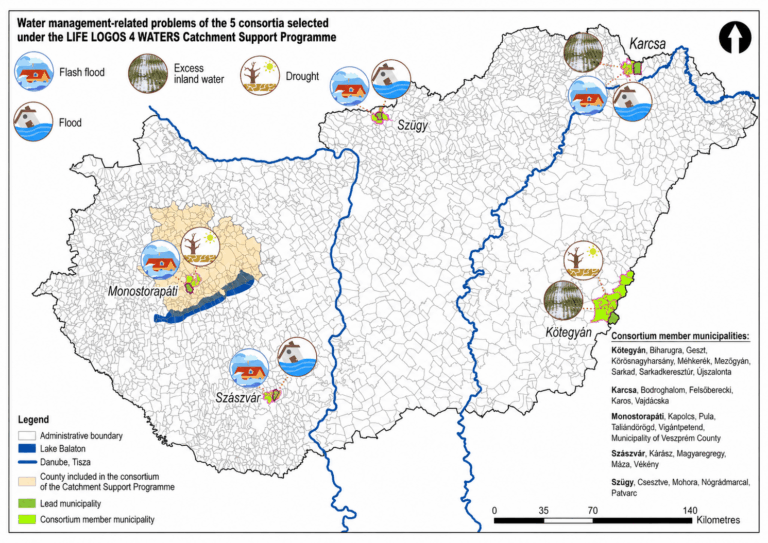
Typical water management-related problems for which expert recommendations are developed within the framework of the Programme: drought, excess inland water, flash floods
The municipalities forming the consortium are located in the Bodrogköz region, in the north-eastern part of Hungary. The area is one of the regions in the country most in need of development, and is also affected by several challenges arising from weather extremes. During periods of severe precipitation deficit, agricultural land dries out, agricultural activities become limited due to drought, and both the quantity and quality of yields deteriorate.
In addition to drought, periodically occurring excess water also poses a problem. In recent years, extensive excess inland water inundations have repeatedly affected the low-lying areas of the settlements, also causing negative impacts for farmers. As a result of increasingly frequent heavy rainfall events, the water levels of smaller watercourses and streams also rise significantly. When these watercourses overflow their beds, they cause inundations and trigger erosion processes. The member municipalities of the consortium are affected by all of the above-mentioned water management-related problems, which occur periodically, alternating with one another. The close cooperation between the settlements, as well as their efforts to develop a liveable and sustainable form of landscape use for the Bodrogköz region, have been clearly visible for several years. Cooperation also appears as a particularly important element of the Programme. Within its framework, water management-related problems can be mitigated through landscape-level, yet small-scale, nature-based solutions that build on the optimisation of water governance in the area. These solutions contribute to increasing biodiversity and to laying the foundations for sustainable landscape management. As an additional, but not negligible, effect, the package of recommendations prepared within the Programme could also contribute to the development of ecotourism in the area and to broad social awareness-raising. As part of this work, by the end of 2024, low-lying areas suitable for receiving excess water will be identified, among other activities, and an assessment and analysis of the stability of the water level of the Karcsa oxbow lake will also be prepared.
Consortium of the Municipality of Kötegyán
Partner municipalities participating in the consortium
- Municipality of Biharugra
- Municipality of Geszt
- Municipality of Körösnagyharsány
- Municipality of Kötegyán
- Municipality of Méhkerék
- Municipality of Mezőgyán
- Municipality of Sarkad
- Municipality of Sarkadkeresztúr
- Municipality of Újszalonta
Typical water management-related problems for which expert recommendations are developed within the framework of the Programme: drought and excess inland water.
One of the main objectives of the Programme is to strengthen cooperation between neighbouring municipalities facing similar water management-related problems. In the case of the consortium led by Kötegyán, this objective has been fully achieved, as cooperation on this scale was initiated among the members through the Support Programme. The area is located in the south-eastern part of Hungary, within the catchment of the Kettős-Körös River. It is one of the driest and warmest regions of the country, where the impacts of weather extremes further intensify water management-related problems. In recent years, drought has reached historic levels across the country, but it has had a particularly negative impact on agriculture in this area. Periodically occurring excess inland water also causes problems when it appears. The main watercourse of the settlements forming the consortium is the Gyepes Main Canal, which has become stagnant in recent years. Since the settlements are located along the national border, water inflow from across the border, or the lack of it, has a determining influence on the water management and water balance of the area. Within the framework of the Programme, the water balance of the area can be improved by ensuring appropriate water governance on the Gyepes Main Canal. This can reduce the differences between water-abundant and water-scarce periods and increase the efficiency of landscape management. In addition, the application of nature-based interventions in the area would also bring positive ecological changes. The Programme also serves as an excellent example of addressing cross-border water management challenges. As part of the package of recommendations to be completed by the end of 2024, low-lying areas suitable for water retention will be surveyed, and the assessment of the area’s water management system and existing land uses will also form part of the work.
Winner Municipalities
Consortium of the Municipality of Monostorapáti
Partner municipalities participating in the consortium:
- Municipality of Kapolcs
- Municipality of Monostorapáti
- Municipality of Pula
- Municipality of Taliándörögd
- Municipality of Veszprém County
- Municipality of Vigántpetend
Typical water management-related problems for which expert recommendations are developed within the framework of the Programme: drought, flash floods, water and soil erosion, and silt accumulation.
The members of the consortium are in the Eger-víz Stream catchment, in the Balaton Uplands, an area characterised by varied landforms and predominantly hilly terrain. The municipalities of the consortium led by Monostorapáti are also supported by the participation and cooperation of the Municipality of Veszprém County within the consortium. The settlements in the area are connected by the Eger-víz Stream. In the case of this group of settlements, which has a rich historical background, cooperation and a shared commitment to joint action have a tradition going back several decades. Due to the topographical conditions of the area, the main water management-related problems are the occurrence of flash floods, the resulting water and soil erosion, and the accumulation of silt. In addition, during heavy rainfall events and wetter periods, floods may also occur, while drought is just as significant a problem here as in lowland areas. During periods of precipitation deficit, the water levels of natural watercourses also decrease considerably, while the beds of intermittent watercourses may dry out completely, contributing to the disruption of the area’s water balance. The package of recommendations to be completed by the end of 2024 will include the mapping and identification of potential water retention areas that may serve as intervention sites for small-scale Natural Water Retention Measures. A key objective of the Programme is to formulate recommendations for exemplary and effective pilot interventions that can also be adapted by other areas facing similar problems. In this way, the Programme also contributes to wider dissemination activities and awareness-raising. In the area of the consortium led by Monostorapáti, the active involvement and information of the local population regarding the condition of the catchment and climate change adaptation has already been successfully ongoing for several years. The aim of the Programme is to further strengthen this cooperation through its results.
Consortium of the Municipality of Szászvár
Partner municipalities participating in the consortium:
- Municipality of Kárász
- Municipality of Magyaregregy
- Municipality of Máza
- Municipality of Szászvár
- Municipality of Vékény
Typical water management-related problems for which expert recommendations are developed within the framework of the Programme: drought, flash floods, and sediment-laden inundations..
The consortium is located in Southern Hungary, in the Eastern Mecsek region, within the catchment area of the Völgységi Stream. Due to the natural geographical characteristics of the area, the most significant water management-related problems are primarily flash floods caused by sudden, intense rainfall events. In recent years, major flash floods causing significant damage occurred in the area in 2005, 2010, 2013 and 2018, resulting in damage to infrastructure networks and buildings located in the settlements. Intense rainfall events are often followed by prolonged dry periods. These problems also pose a risk to drinking water resources in the area. Recognising the benefits and impacts of addressing these problems jointly, the settlements forming the consortium have maintained close cooperation for a long time. As part of this cooperation, they have established an internal warning system within the catchment area in order to monitor the passage of flash floods and floods, and to ensure and carry out the necessary protection measures and tasks in the individual settlements as effectively as possible, thereby also supporting one another. Within the framework of the Programme, as part of the package of recommendations to be prepared by the end of 2024, the main focus of the assessment will be the interpretation and analysis of water management-related problems and their impacts identified in the sub-catchment areas designated on the basis of runoff data for the area. Subsequently, recommendations will be formulated to identify possible intervention options for small-scale nature-based solutions and to designate potential intervention sites. In the area of the consortium, the objective is to improve the balance of the water regime through complex close-to-nature solutions that ensure sustainable water management in the long term and contribute to mitigating the negative impacts of climate change. These interventions may also serve as exemplary solutions for other areas facing similar problems.
Consortium of the Municipality of Szügy
Consortium of the Municipality of Szügy
Partner municipalities participating in the consortium:
- Municipality of Csesztve
- Municipality of Mohora
- Municipality of Nógrádmarcal
- Municipality of Patvarc
- Municipality of Szügy
Typical watermanagement-related problems for which expert recommendations are developed within the framework of the Programme: drought, flash floods, soil erosion, groundwater level decline, and excess inland water.
The consortium is located in Northern Hungary, in Nógrád County. One of the most significant tributaries of the Ipoly River is the Fekete-víz Stream, and the municipalities participating in the Programme are situated within its catchment area.The area is characterised by varied topographical conditions, which is also reflected in the range of water management-related problems present. During intense rainfall events, flash floods may occur, threatening built-up areas located close to watercourses and intensifying soil erosion processes. In flat areas, excess inland water also poses a problem, primarily from the perspective of agricultural cultivation. During periods of precipitation deficit, the area is affected by drought, while the decline in groundwater levels also represents a particularly significant problem. In some outlying residential areas of the settlements, residents use water from dug wells; however, due to falling groundwater levels, this water is becoming increasingly difficult for them to access. The natural environment is also adversely affected by the above-mentioned water management problems. Therefore, improving the water balance of the area would also be of particular importance from an ecological perspective. The cooperation between the settlements forming the consortium was initiated by the Programme, which has already contributed to awareness-raising in the area and to strengthening cooperation between municipalities. As part of the package of recommendations to be completed by the end of 2024, the detailed analysis of watercourses and areas along streams passing through the settlements will receive particular attention, together with the identification of low-lying areas suitable for diverting flood waves. In addition, areas exposed to erosion risks, typically those threatened by mud and silt inundations, will also be surveyed within the framework of the Programme. In these areas, the possibility of applying small-scale runoff-slowing measures will be assessed in order to mitigate the identified problems.
In the area of each consortium, awareness-raising is of key importance, together with the dissemination of landscape-based, water-retention-oriented land management. Accordingly, intervention options, assessment results and the expected positive impacts of the proposed measures, if implemented, will be presented to local residents and farmers at forums.